Understanding Florida’s Strict Sex Offender Registry & Residency Laws
If you or a loved one is required to register as a sex offender in Florida, you face some of the toughest restrictions in the nation. At Russo Law & Advocacy, we help clients navigate Florida sex offender laws, including:
✔ Registration requirements
✔ Residency restrictions
✔ Employment limitations
✔ Travel and internet rules
Below, we break down the key laws, penalties for violations, and possible legal defenses.
Florida Sex Offender Registration Requirements

Under Florida Statute § 943.0435, convicted sex offenders must:
✅ Register in person at their local sheriff’s office:
- Every 6 months (for most offenders)
- Every 3 months (if designated a sexual predator)
- Update information within 48 hours of any change (address, job, vehicle)
- Provide DNA samples (added to state/federal databases)
- Renew driver’s license/ID annually (marked SEX OFFENDER)
Failure to register is a 3rd-degree felony (up to 5 years in prison).
Where Can Sex Offenders Live in Florida?
Florida enforces strict residency restrictions under Florida Statute § 775.215:
🚫 Cannot live within 1,000 feet of:
- Schools
- Daycares
- Parks
- Playgrounds
- Bus stops
🚫 Some cities/counties impose even stricter rules (e.g., Miami-Dade bans offenders from living near churches).
Challenges for Sex Offenders Finding Housing
Many offenders end up in:
✔ Homeless camps (under bridges, in remote areas)
✔ Motels outside restricted zones
✔ Specialized transitional housing
Legal Note: Some offenders successfully challenge restrictions in court if they prove no minors were involved in their crime.
What Are Sex Offenders Not Allowed to Do in Florida?
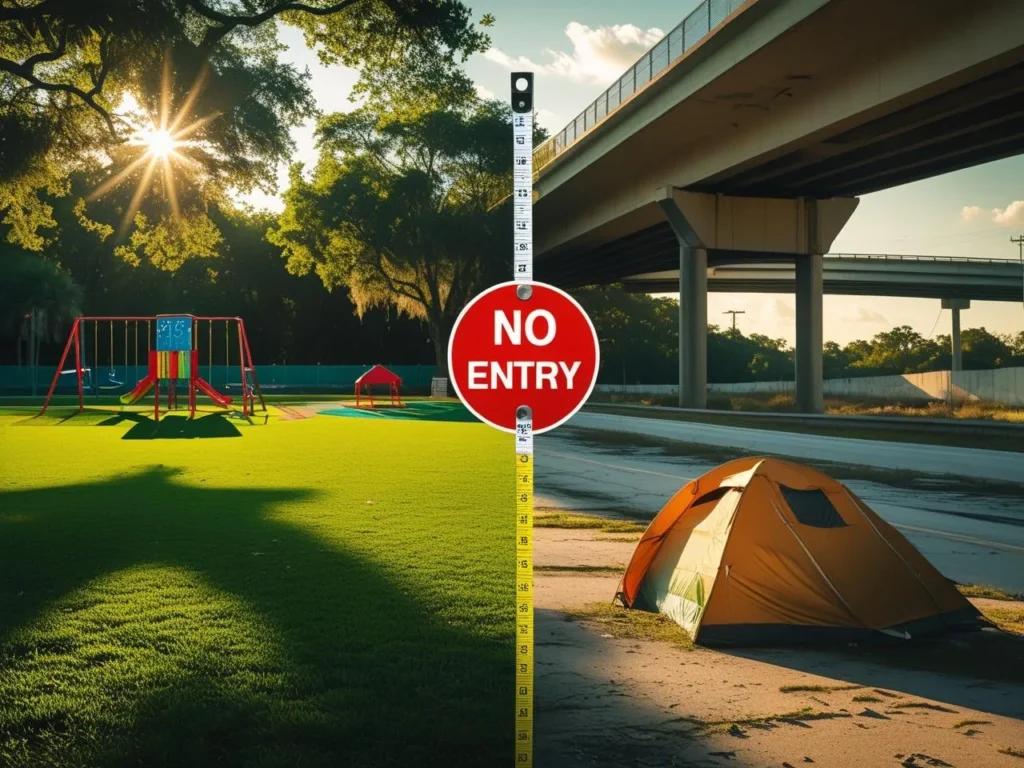
Beyond residency rules, sex offenders face lifetime limitations:
❌ Work with children (even volunteer roles)
❌ Visit schools or playgrounds (without prior approval)
❌ Use social media if minors can access it
❌ Change jobs without notifying law enforcement
❌ Travel internationally without permission
Violations can lead to new felony charges.
Penalties for Violating Florida Sex Offender Laws
| Violation | Charge | Possible Sentence |
|---|---|---|
| Failure to Register | 3rd-degree felony | Up to 5 years prison |
| Living Near School | 3rd-degree felony | Up to 5 years prison |
| Unauthorized Travel | 2nd-degree misdemeanor | Up to 60 days jail |
Possible Defenses Against Sex Offender Reporting Charges
If you’re accused of violating Florida sex offender laws, we may argue:
✅ Inaccurate Address Reporting (GPS data proves compliance)
✅ No Proper Notice (You weren’t informed of new restrictions)
✅ Unconstitutional Restrictions (If rules are overly harsh for your case)
FAQs About Florida Sex Offender Laws
1. How often do sex offenders have to register in Florida?
Most must register every 6 months; sexual predators every 3 months.
2. Can a sex offender live with their own children?
Sometimes, but Child Protective Services may intervene if minors are present.
3. Do these laws apply to juvenile offenders?
Yes, unless the case was sealed/expunged.
4. Can sex offenders go to the beach in Florida?
Depends—many beaches are near parks, which may be off-limits.
5. Can these restrictions be reduced?
Rarely, but legal challenges are possible in federal court.
Need Help With Florida Sex Offender Laws? Call Today
If you’re struggling with registration, housing, or probation issues, Dominique Russo at Russo Law & Advocacy can help. We serve clients in:
📍 Palm Beach County (West Palm Beach, Boca Raton)
📍 Broward County (Fort Lauderdale, Hollywood)
📍 Miami-Dade County (Miami, Homestead)
📞 Free Consultation
“Don’t let a past mistake control your future. We fight for fair treatment under Florida law.”