Understanding Prescription Drug Fraud in Florida
When people think of drug crimes, they often imagine illegal narcotics like cocaine or heroin. However, prescription drug fraud involving medications like oxycodone, Xanax, and Adderall is treated just as severely under Florida law. At Russo Law & Advocacy, Dominique Russo defends clients across Palm Beach, Broward, and Miami-Dade Counties against these complex charges, building defenses that address the unique circumstances of prescription drug cases. Whether you are facing allegations of doctor shopping or unlawful possession, securing a knowledgeable attorney for drug possession early in the process can significantly impact the outcome of your case.
Many individuals facing these charges are not traditional drug dealers. They may be chronic pain patients, individuals with undiagnosed mental health conditions, or people who made poor decisions while struggling with addiction. Understanding the legal landscape is the first step toward building an effective defense. A skilled drug lawyer understands the nuances of Florida’s prescription drug laws and can identify weaknesses in the prosecution’s case.
For a broader overview of drug-related offenses, see our page on florida drug charge.
What is Prescription Drug Fraud?
Prescription drug fraud encompasses a range of illegal activities involving prescription medications. Under Florida law, these offenses are prosecuted aggressively, often as felonies.
Common Types of Prescription Drug Fraud
✅ Doctor shopping – Visiting multiple doctors to obtain overlapping prescriptions
✅ Prescription forgery – Altering or creating fake prescriptions
✅ Pharmacy fraud – Using fraudulent prescriptions to obtain medications
✅ Impersonating a medical professional – Pretending to be a doctor to prescribe medications
✅ Internet pharmacy fraud – Obtaining prescriptions through unlicensed online pharmacies
Prescription Forgery Explained
Prescription forgery involves creating, altering, or using a fraudulent prescription to obtain controlled substances. This can include:
- Changing the quantity on a legitimate prescription
- Forging a doctor’s signature
- Using stolen prescription pads
- Calling in fake prescriptions to pharmacies
Is Doctor Shopping Illegal in Florida?
What is Doctor Shopping?
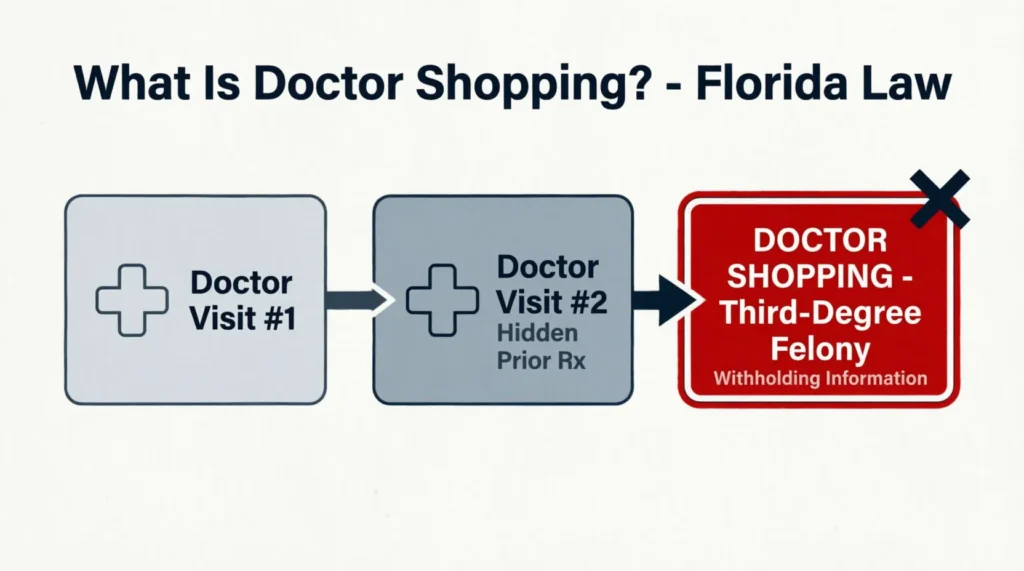
What is doctor shopping in drug terms? “Doctor shopping” refers to the practice of visiting multiple healthcare providers to obtain overlapping prescriptions for controlled substances without revealing prior prescriptions.
What is Doctor Shopping Legally?
What is doctor shopping under Florida law? It is defined in Florida Statute § 893.13(7)(a)9 as knowingly withholding information from a practitioner about prior prescriptions for controlled substances within the preceding 30 days.
Is Doctor Shopping Illegal?
Yes, is doctor shopping illegal absolutely. In Florida, it is a third-degree felony punishable by up to 5 years in prison and fines up to $5,000.
Why Do People Doctor Shop?
Understanding what is doctor shopping in drug terms often reveals underlying issues:
- Untreated chronic pain – Legitimate patients seeking relief
- Addiction – Individuals with substance use disorders
- Mental health conditions – Self-medicating undiagnosed issues
For clients whose prescription drug charges stem from underlying addiction or mental health struggles, treatment-focused alternatives may be available. See our page on drug abuse and mental health for more information. An experienced attorney for drug possession can help identify whether diversion programs or treatment courts are viable options in your case.
Oxycodone: A Closely Regulated Substance
What is Oxycodone?
Is oxycodone addictive? Yes, oxycodone is a powerful semi-synthetic opioid prescribed for moderate to severe pain. It is classified as a Schedule II controlled substance under federal and Florida law, meaning it has a high potential for abuse and addiction.
Possession of Oxycodone
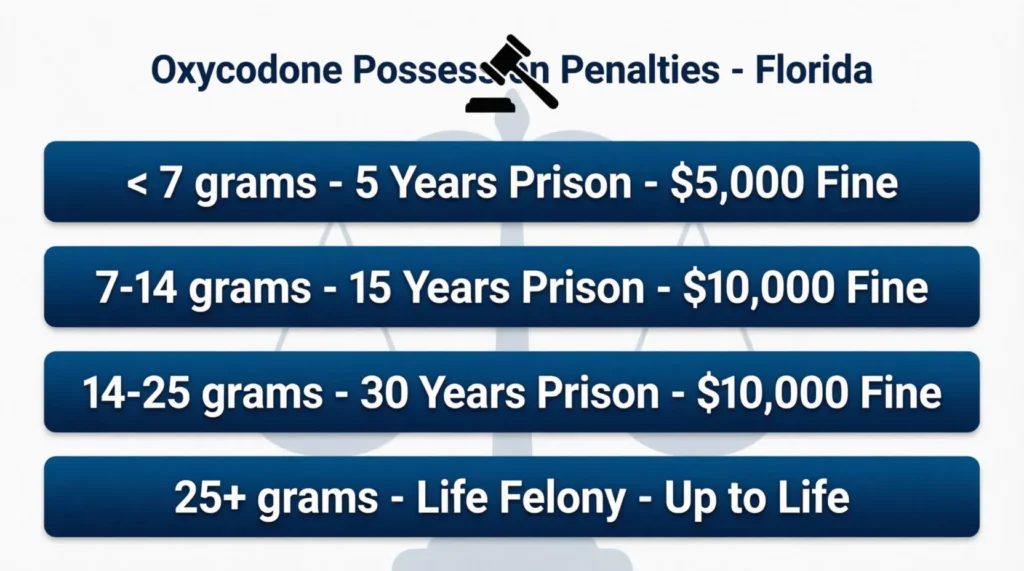
Possession of oxycodone without a valid prescription is a serious crime. Penalties depend on the quantity:
| Quantity | Charge Level | Maximum Penalty |
|---|---|---|
| Less than 7 grams | Third-degree felony | 5 years prison, $5,000 fine |
| 7 grams to less than 14 grams | Second-degree felony | 15 years prison, $10,000 fine |
| 14 grams to less than 25 grams | First-degree felony | 30 years prison, $10,000 fine |
| 25 grams or more | Life felony | Up to life in prison |
What Does Possession of a Controlled Substance Mean?
Clients often ask what does possession of a controlled substance mean legally. Under Florida law, possession can be either:
Actual Possession
- The drug is found on your person (in your pocket, hand, etc.)
- Direct physical control over the substance
Constructive Possession
- The drug is found in a place you control (your car, home, etc.)
- You have knowledge of the drug’s presence
- You have the ability to maintain control over it
Understanding what is possession of narcotics legally is crucial because many prescription drug cases involve constructive possession in shared spaces like cars or homes. A knowledgeable drug lawyer can challenge constructive possession allegations when the evidence does not clearly establish knowledge and control.
Penalties for Prescription Drug Fraud
Misdemeanor vs. Felony Classification
Most prescription drug fraud offenses are felonies in Florida. Penalties include:
| Offense | Classification | Maximum Penalty |
|---|---|---|
| Doctor Shopping | Third-degree felony | 5 years prison, $5,000 fine |
| Prescription Forgery | Third-degree felony | 5 years prison, $5,000 fine |
| Obtaining by Fraud | Third-degree felony | 5 years prison, $5,000 fine |
| Trafficking Oxycodone | First-degree felony | Up to life in prison |
Additional Consequences
- Permanent felony record
- Loss of professional licenses (especially for healthcare workers)
- Medicare/Medicaid exclusion (for healthcare providers)
- Difficulty finding employment and housing
- Immigration consequences for non-citizens
Defense Strategies for Prescription Drug Fraud

A skilled lawyer for drug charges can employ multiple defense strategies. Whether you work with a dedicated attorney for drug possession or an experienced drug lawyer, the following defenses may be available:
1. Lack of Intent
The prosecution must prove you knowingly and intentionally committed fraud. If you had a valid prescription, were confused about the law, or lacked criminal intent, this can be a powerful defense.
2. Medical Necessity
For patients with chronic pain or untreated conditions, the actions may have been driven by legitimate medical need rather than criminal intent.
3. Entrapment
If law enforcement induced you to commit a crime you would not otherwise have committed, this may be a valid defense.
4. Illegal Search and Seizure
If evidence was obtained through an unlawful search or traffic stop, it may be suppressed, leading to dismissal of charges.
5. Challenging the Knowledge Element
In constructive possession cases, we challenge whether you knew the substances were present or had control over them.
6. Treatment Diversion
For clients with addiction issues, we may seek admission to drug court or mental health court programs. Learn more about what is mental health court and how it can provide an alternative to incarceration.
The Importance of Early Legal Intervention
In prescription drug fraud cases, evidence is often documentary—prescription records, pharmacy logs, and doctor’s notes. Preserving and analyzing this evidence early is critical:
✅ Secure medical records before they are lost or altered
✅ Identify all prescribing doctors and pharmacies
✅ Document legitimate medical conditions and treatment history
✅ Preserve evidence of pain management attempts
✅ Challenge search warrants for medical records
Frequently Asked Questions
1. Can I go to jail for doctor shopping in Florida?
Yes, doctor shopping is a third-degree felony punishable by up to 5 years in prison.
2. What if I had a valid prescription but filled it early?
This depends on the circumstances. If you have a legitimate medical need and your doctor approved early refills, you may have a defense. Consulting with a drug lawyer can help clarify your options.
3. Is oxycodone possession always a felony?
Possession without a prescription is always at least a felony. However, quantities under 7 grams are third-degree felonies, while larger amounts carry higher penalties.
4. Can healthcare professionals lose their licenses for prescription fraud?
Yes, absolutely. A conviction can result in permanent license revocation, Medicare/Medicaid exclusion, and career destruction. An experienced attorney for drug possession can work to protect your professional license and reputation.
5. Do you handle prescription drug cases throughout South Florida?
Yes. We serve all South Florida counties, including:
- Miami-Dade County (Miami, Coral Gables, Hialeah)
- Palm Beach County (West Palm Beach, Boca Raton, Jupiter)
- Broward County (Fort Lauderdale, Hollywood, Pembroke Pines)
Facing Prescription Drug Fraud Charges? Get Defense Help Now
If you’re facing prescription drug fraud charges involving oxycodone, doctor shopping, or prescription forgery, your future is at risk. Contact Dominique Russo at Russo Law & Advocacy for a free consultation. We serve clients across South Florida, including:
📍 Palm Beach County (West Palm Beach, Boca Raton, Jupiter)
📍 Broward County (Fort Lauderdale, Hollywood, Pembroke Pines)
📍 Miami-Dade County (Miami, Coral Gables, Hialeah)
📞 Free Consultation
“Prescription drug charges can arise from genuine medical needs or addiction struggles. We fight to uncover the full context and build the strongest possible defense.”