Quick Answer
Being found incompetent to stand trial in Florida means a criminal defendant lacks the current mental capacity to understand court proceedings or assist their defense attorney. Under Florida Statute Section 916.12, incompetence is a temporary legal status focusing on the defendant’s present mental state. When someone is found incompetent to stand trial in florida, criminal prosecution pauses while court-ordered treatment or restoration services are provided.
Navigating the criminal justice system is daunting for any individual, but when severe mental illness or cognitive impairment interferes, fundamental constitutional questions arise. The United States Constitution guarantees that every defendant must be capable of understanding the charges against them and participating meaningfully in their own legal defense. When a individual is declared incompetent to stand trial in florida, the judicial process shifts focus from criminal punishment to psychological evaluation and mental health stabilization. Attorney Dominique Russo guides individuals and families across South Florida through these intricate legal procedures, ensuring that constitutional rights remain safeguarded at every stage.
What Does Incompetent to Stand Trial Mean Under Florida Law?
To understand the legal standard, one must answer a foundational question: what does incompetent to stand trial mean in daily practice? Incompetency does not measure intelligence, nor is it identical to a legal defense of insanity at the time of an offense. Instead, competency evaluates a defendant’s current mental condition during criminal proceedings.
Legal Criteria for Competency Under Florida Statute 916.12
Under Florida Statutes Chapter 916, specifically Section 916.12, a defendant is considered incompetent if they lack sufficient present ability to consult with counsel with a reasonable degree of rational understanding, or if they lack a rational and factual understanding of the court proceedings. Judges and court-appointed experts evaluate specific factors, including the defendant’s ability to appreciate the charges, understand courtroom roles, appreciate potential penalties, manifest appropriate courtroom behavior, and testify relevantly.
| Legal Concept | Timeframe Evaluated | Primary Legal Objective | Primary Outcome |
|---|---|---|---|
| Incompetent to Stand Trial | Present moment (during pre-trial or trial) | Ensure fair trial and due process | Pause prosecution; order competency restoration |
| Not Guilty by Reason of Insanity (NGRI) | Past moment (time of the alleged crime) | Determine criminal responsibility | Acquittal with potential involuntary commitment |
| Competent to Stand Trial | Present moment (during proceedings) | Proceed with normal criminal prosecution | Plea negotiations, trial, or case resolution |
The Mental Health Evaluation Process in South Florida
When defense attorneys, prosecutors, or judges raise concerns about a defendant’s mental state, the court immediately stays formal proceedings to order psychological evaluations. Qualified mental health experts examine the defendant to determine whether legal incompetency exists due to mental illness, intellectual disability, or co-occurring issues involving drug abuse and mental health conditions.
Local court systems across South Florida implement Florida Rule of Criminal Procedure 3.210 through localized forensic health services. Although state standards apply uniformly, county procedures reflect local community resources and court dockets.
| South Florida Jurisdiction | Local Judicial Circuit | Primary Forensic Evaluation Unit | Diversion & Court Specialty Options |
|---|---|---|---|
| Palm Beach County (West Palm Beach, Boca Raton, Jupiter) | 15th Judicial Circuit | Court Psychology Clinic / Local Forensic Evaluators | Palm Beach County Mental Health Specialty Court |
| Broward County (Fort Lauderdale, Hollywood, Pembroke Pines) | 17th Judicial Circuit | Broward Forensic Mental Health Division | Broward County Mental Health Court Division |
| Miami-Dade County (Miami, Coral Gables, Hialeah) | 11th Judicial Circuit | Eleventh Circuit Forensic Evaluation Unit | Criminal Mental Health Project (CMHP) |
The Role of Florida Mental Health Court and Treatment Options
Once an evaluation concludes that a defendant is incompetent to stand trial in florida, the judge enters an order for treatment. The primary goal of treatment is competency restoration. Many defendants ask, what is mental health court and how does it assist in this process?
A specialized florida mental health court operates to divert eligible non-violent individuals suffering from psychiatric disorders or severe substance dependence into comprehensive community-based care. In felony cases, defendants declared incompetent may be committed to state mental health facilities, such as South Florida State Hospital, or placed in community outpatient restoration programs managed by local providers. When cases involve complex factors such as dual diagnosis, courts address both drug abuse and mental health stabilization simultaneously.
How Dominique Russo Protects Your Legal Rights
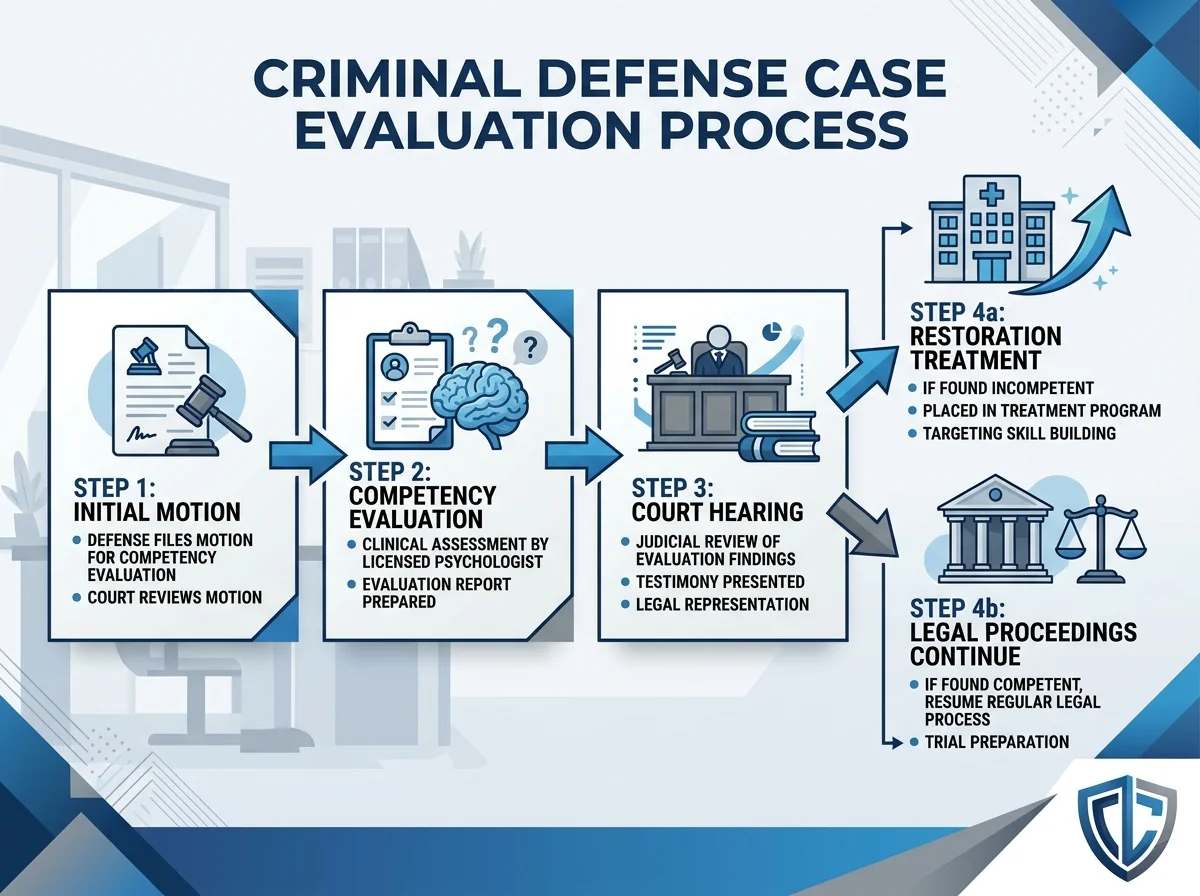
When facing criminal charges while struggling with mental health challenges, robust legal defense is essential. Attorney Dominique Russo ensures that competency evaluations are conducted thoroughly and fairly. If a client is declared incompetent to stand trial in florida, our firm closely monitors treatment progress, opposes unnecessary involuntary confinement, and advocates for community-based outpatient restoration whenever feasible.
Every case requires a customized approach that balances mental health advocacy with aggressive protection of statutory rights. Dominique Russo regularly represents clients across Palm Beach, Broward, and Miami-Dade counties, working diligently to protect constitutional guarantees and seek case dismissals when restoration is legally unachievable.
Frequently Asked Questions (FAQ) about Incompetent to Stand Trial in Florida
Does being incompetent to stand trial mean charges are automatically dropped?
No, finding a defendant incompetent to stand trial in florida does not automatically result in dropped charges. Instead, criminal proceedings are paused while the defendant receives competency restoration treatment. However, under Florida rules, if competency cannot be restored within statutory time limits (typically three years for most felonies), the defense attorney can petition the court to dismiss the criminal charges without prejudice.
How long can someone be held if found incompetent to stand trial in Florida?
Florida law limits how long a defendant can remain committed solely for competency restoration. In felony cases, the court periodically reviews competency status every six months. If mental health professionals determine there is no substantial probability the defendant will regain competency in the foreseeable future, charges may eventually be dismissed, though civil commitment procedures under Florida’s Baker Act may apply.
What is the main difference between legal insanity and legal incompetence?
Incompetence to stand trial focuses strictly on a defendant’s present mental state during court proceedings and their ability to assist counsel. Legal insanity refers specifically to the defendant’s mental state at the exact time the alleged crime occurred, evaluating whether they understood the nature or wrongfulness of their actions.
Can outpatient treatment be ordered instead of state hospitalization?
Yes. If the court determines that the defendant does not pose a severe physical danger to themselves or the community, outpatient competency restoration treatment may be ordered. This allows the individual to receive treatment while living in community housing or under family supervision in Palm Beach, Broward, or Miami-Dade counties.
How does a mental health court differ from traditional criminal court?
A Florida mental health court prioritizes rehabilitation, mental health treatment, and recovery over punitive incarceration. It involves a collaborative team, including specialized judges, defense attorneys, state prosecutors, and mental health case managers who oversee treatment plans tailored to the defendant’s mental health and substance use needs.
Get a Defense Attorney Now
Contact Dominique Russo at Russo Law & Advocacy for a complimentary consultation. We serve clients across South Florida, including:
- Palm Beach County (West Palm Beach, Boca Raton, Jupiter)
- Broward County (Fort Lauderdale, Hollywood, Pembroke Pines)
- Miami-Dade County (Miami, Coral Gables, Hialeah)