Understanding Battery with a Deadly Weapon in Florida
When a simple physical altercation involves a weapon, Florida law treats the offense with the utmost severity. Battery with a deadly weapon is not a simple misdemeanor, it is a serious felony that can lead to years in prison and a permanent criminal record. At Russo Law & Advocacy, Dominique Russo defends clients across Palm Beach, Broward, and Miami-Dade Counties against these grave allegations. Her background as a former private investigator, turned defense attorney, is critical for analyzing the facts, challenging the prosecution’s evidence, and building a robust defense.
Many people confuse the specific charges of assault and battery. It is important to understand that this offense is a specific, aggravated form of battery. For a clear breakdown of the basic charges, you can review our guide on assault vs battery in florida. However, when a weapon enters the equation, the legal landscape changes dramatically under Florida Statute 784.021.
What is Battery with a Deadly Weapon?
Under Florida Statute § 784.045, aggravated battery occurs when a person, in committing a battery:
- Intentionally or knowingly causes great bodily harm, permanent disability, or permanent disfigurement, OR
- Uses a deadly weapon.
This second prong is what is commonly referred to as battery with a weapon or battery with a deadly weapon. The “use” of the weapon does not necessarily mean striking someone with it; it can include displaying it in a threatening manner during the battery.
Key Elements the Prosecution Must Prove
For a conviction, the state must prove beyond a reasonable doubt that:
✅ A battery occurred (actual and intentional touching or striking against another’s will).
✅ The battery was committed with a deadly weapon.
✅ The defendant had the intent to commit the battery.
Deadly Weapon Definition in Florida

A central question in these cases is the deadly weapon definition. Florida law does not limit this to items designed to kill, like guns or knives. The definition is broader and depends on how an object is used.
What Qualifies as a Deadly Weapon?
Under Florida law and court interpretations, a deadly weapon is any object or instrument that, when used in the ordinary manner contemplated, is likely to cause great bodily harm or death. This can include:
- Firearms of any kind (loaded or unloaded)
- Knives, razors, or box cutters
- Blunt objects like baseball bats, clubs, or heavy flashlights
- Vehicles used as a weapon
- Everyday objects used in a dangerous way (e.g., a glass bottle smashed and used to strike someone, a heavy tool)
The prosecution will often argue that any object used in a manner capable of causing serious injury qualifies. This is a critical point of contention where a skilled defense attorney can challenge their interpretation.
Penalties: What Are the Charges for Assault and Battery When a Weapon is Involved?
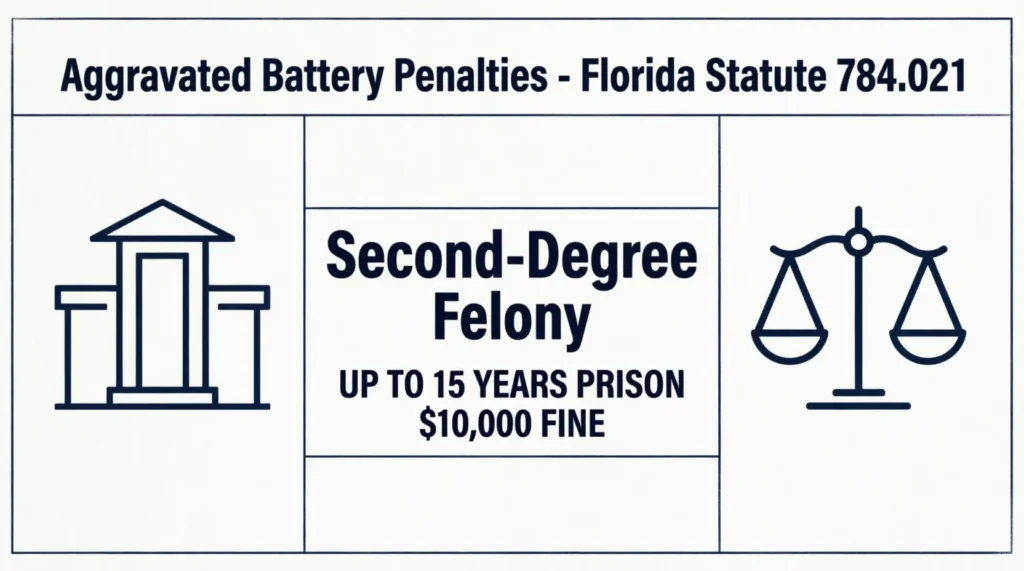
The penalties for battery with a deadly weapon are severe because it is classified as Aggravated Battery.
Classification and Sentencing
- Charge Level: Second-Degree Felony
- Maximum Prison Sentence: Up to 15 years in Florida State Prison
- Maximum Fines: Up to $10,000
Enhanced Penalties
The penalties can increase under specific circumstances:
- Firearm Use: If a firearm is used, federal charges or enhanced state sentences under Florida’s 10-20-Life law may apply.
- Victim Status: If the victim was a law enforcement officer, an elderly person, a disabled adult, or a minor, the charge can be elevated to a First-Degree Felony, punishable by up to 30 years in prison.
- Prior Record: A defendant with a prior violent criminal history faces harsher sentencing guidelines.
For more detail on related violent crimes, you can see our page on aggravated assault and battery.
Defenses to Battery with a Deadly Weapon Charges

Being charged with this crime does not mean a conviction is inevitable. Common defense strategies include:
1. Self-Defense (Stand Your Ground)
Florida’s powerful self-defense laws can provide immunity from prosecution. If you used force to protect yourself from imminent death or great bodily harm, you may be protected under Florida’s Stand Your Ground law. Learn more about how this applies on our pages about florida’s stand your ground law and understanding stand your ground laws in palm beach.
2. Lack of Deadly Weapon
A strong defense is arguing that the object used does not meet the legal deadly weapon definition or was not used in a manner likely to cause great harm.
3. Challenging Intent
The prosecution must prove you acted intentionally. If the contact was accidental, or if you lacked the specific intent to commit a battery, the charges may be reduced or dismissed.
4. Misidentification
In the chaos of a fight, witnesses may incorrectly identify the person who used a weapon. We scrutinize witness statements and identification procedures for errors.
5. False Accusations
These charges can arise from anger or revenge in domestic disputes or conflicts between acquaintances. We investigate the accuser’s background and motive to uncover the truth.
6. Defense of Others
Similar to self-defense, you are legally allowed to use reasonable force to defend another person from what you reasonably believe to be imminent harm.
The Importance of Early Investigation
In cases involving weapons, evidence is time-sensitive. Surveillance footage may be overwritten, witnesses may move, and memories fade. That is why taking immediate action is crucial:
✅ Locate and preserve surveillance video from nearby businesses or residences.
✅ Identify and interview independent witnesses before the prosecution does.
✅ Photograph and document the scene to preserve crucial details.
✅ Secure and review any 911 calls and police reports for inconsistencies.
This proactive, investigative approach is the cornerstone of an effective defense against serious felony charges.
Frequently Asked Questions
1. What is the difference between aggravated assault and aggravated battery with a deadly weapon?
Aggravated assault is a threat with a weapon that places someone in fear, but no physical contact occurs. Aggravated battery with a deadly weapon involves the weapon being used to make actual, unwanted physical contact.
2. Can I be charged if I only showed a weapon but didn’t hit anyone?
Yes. If you display a deadly weapon during a battery, you can be charged with aggravated battery under the “use of a deadly weapon” prong. The “use” includes threatening with it.
3. Is a car considered a deadly weapon?
Yes, a vehicle can be considered a deadly weapon if it is used in a manner likely to cause great bodily harm or death, such as intentionally hitting someone with it.
4. What should I do immediately after being charged?
Do not speak to the police or anyone else about the case without your lawyer present. Preserve any evidence you have, such as text messages, photos, or videos, and contact a defense attorney immediately.
5. What are the long-term consequences of a conviction?
Beyond prison time, a felony conviction results in the permanent loss of firearm rights, significant difficulty finding employment and housing, loss of professional licenses, and potential immigration consequences.
Facing Battery with a Deadly Weapon Charges? Get Defense Help Now
If you are facing charges for battery with a deadly weapon in Florida, your future is at risk. Contact Dominique Russo at Russo Law & Advocacy for a free consultation. We serve clients across South Florida, including:
📍 Palm Beach County (West Palm Beach, Boca Raton, Jupiter)
📍 Broward County (Fort Lauderdale, Hollywood, Pembroke Pines)
📍 Miami-Dade County (Miami, Coral Gables, Hialeah)
📞 Free Consultation
“A charge involving a deadly weapon requires an investigator’s mindset and a defender’s resolve. We dig deep to uncover the truth and build your strongest defense.”