
Understanding Theft Charges in Palm Beach County
If you’ve been arrested for stealing property in Florida, the severity of your charges hinges on one critical question: petty theft vs grand theft. While both involve taking someone else’s property without permission, the distinction determines whether you face a misdemeanor or a felony, impacting your freedom, record, and future for years to come.
At Russo Law & Advocacy, Dominique Russo, a former private investigator, turned defense attorney, defends clients across Palm Beach, Broward, and Miami-Dade Counties against all types of theft allegations. Her investigative background provides a unique advantage in examining evidence, challenging witness credibility, and uncovering the facts needed to build a strong defense against shoplifting criminal charges and other theft crimes.
Understanding theft crime penalties is the first step in protecting your rights.
What is the Difference Between Petty Theft and Grand Theft?
The primary difference between petty and grand theft in Florida is the value of the property taken and, in some cases, the type of property. Under Florida Statute § 812.014, theft is defined as knowingly obtaining or using another person’s property with the intent to either temporarily or permanently deprive them of their right to the property.
Petty Theft (Petit Theft)
- Value of property: Less than $750
- Classification: Generally a misdemeanor
- Severity: Can be a first or second-degree misdemeanor depending on value
Grand Theft
- Value of property: $750 or more
- Classification: A felony (ranging from third to first-degree)
- Severity: Penalties increase significantly with higher values and specific property types
Misdemeanor vs Felony Theft: A Quick Comparison
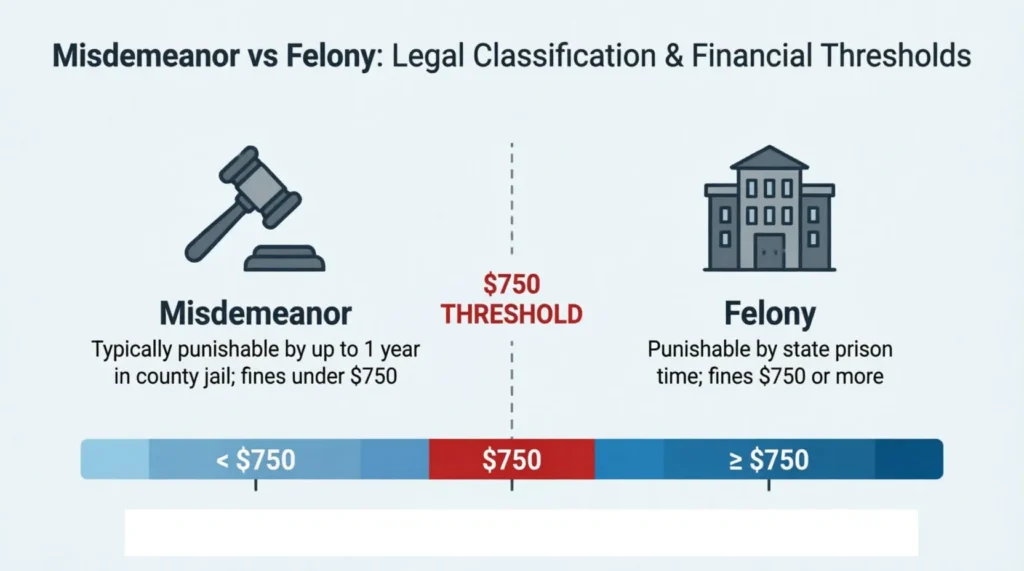
| Aspect | Petty Theft (Misdemeanor) | Grand Theft (Felony) |
|---|---|---|
| Property Value | Under $750 | $750 or more |
| Jail/Prison | Up to 1 year (county jail) | Starting at 5 years (state prison) |
| Fines | Up to $1,000 | Up to $5,000 – $10,000+ |
| Long-Term Impact | Misdemeanor record | Permanent felony record, loss of rights |
Petty Theft (Petit Theft) in Florida: Penalties & Charges
Petty theft, often arising from incidents like shoplifting charges, is governed by the value of the stolen item.
First-Degree Petit Theft
- Value: $100 or more but less than $750
- Classification: First-degree misdemeanor
- Penalties: Up to 1 year in jail, fines up to $1,000
Second-Degree Petit Theft
- Value: Less than $100
- Classification: Second-degree misdemeanor
- Penalties: Up to 60 days in jail, fines up to $500
Even a misdemeanor conviction for petty theft can have lasting consequences. It can appear on background checks, potentially impacting your ability to get a job, rent an apartment, or gain admission to certain schools.
Grand Theft in Florida: When a Misdemeanor Becomes a Felony
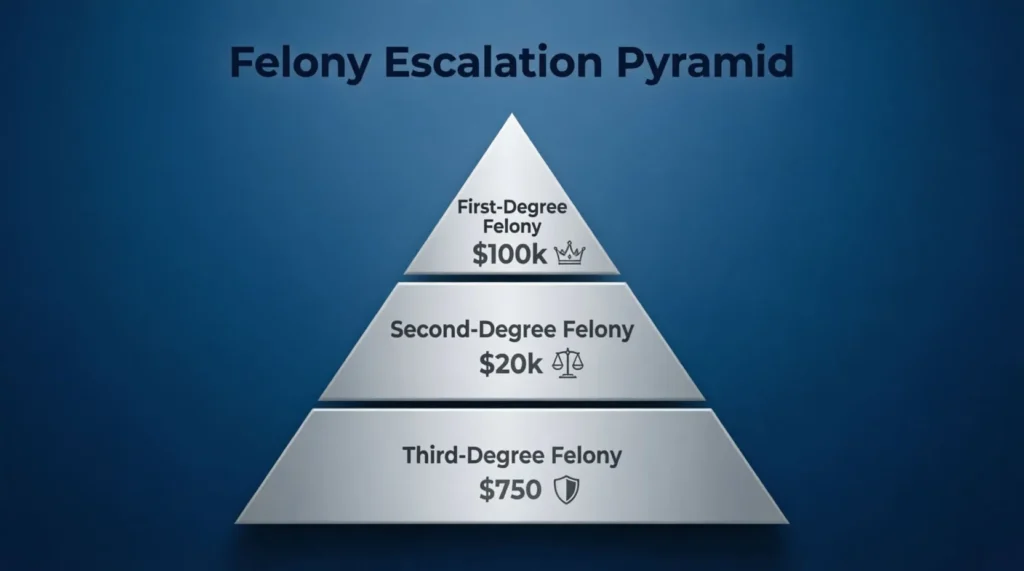
Once the value of the stolen property reaches $750 or more, the charge escalates to grand theft, a felony. The degree of the felony increases with the value of the property, leading to harsher sentences under theft crime penalties.
Degrees of Grand Theft
| Degree | Value of Property | Maximum Prison Sentence | Maximum Fine |
|---|---|---|---|
| Third-Degree Felony | $750 to $19,999 | 5 years | $5,000 |
| Second-Degree Felony | $20,000 to $99,999 | 15 years | $10,000 |
| First-Degree Felony | $100,000 or more | 30 years | $10,000 |
Grand Theft by Property Type
Regardless of value, stealing certain types of property is automatically classified as a felony. This includes:
- Cargo from a truck or vessel (Third-degree felony)
- Firearms or destructive devices (Second or Third-degree felony)
- Motor vehicles, including cars, trucks, and boats (Third-degree felony)
- Will, codicil, or other testamentary instrument (Second-degree felony)
- Anhydrous ammonia (Third-degree felony)
Theft Charges Lawyer: Defenses Against Theft Allegations
If you are facing theft charges, the specific defenses available will depend on the details of your case. As a theft charges lawyer, Dominique Russo’s experience as a former investigator allows her to dissect the prosecution’s case and identify weaknesses. Common defense strategies include:
- Lack of Intent: The prosecution must prove you intended to permanently deprive the owner of their property. Actions like accidentally walking out of a store without paying for an item may lack criminal intent.
- Mistaken Identity: Theft can happen quickly, and eyewitnesses are not always reliable. Surveillance footage can be grainy, and descriptions can be inaccurate.
- False Accusations: In some cases, especially in disputes between individuals, theft accusations are fabricated out of revenge, anger, or to gain leverage in another matter (like a divorce).
- Rightful Ownership: A strong defense is proving that you had a good-faith claim of ownership to the property in question.
- Duress or Coercion: If someone threatened you with harm unless you committed the theft, you may have a valid defense.
- Challenging the Property’s Value: The value assigned to the stolen property is critical. We can challenge the valuation methods used, potentially reducing the value below the felony threshold.
Related Crimes: Vandalism and Criminal Mischief
Theft crimes are sometimes accompanied by property damage. For instance, stealing a car might involve breaking a window, or shoplifting criminal charges might include tearing a sensor tag off clothing. These acts can lead to separate charges for vandalism or criminal mischief.
For more information on defending against these related charges, see our page on criminal mischief lawyer.
Why You Need a Criminal Defense Lawyer Immediately After an Arrest

The moments after an arrest are critical. Police may try to question you, hoping you’ll say something that incriminates you. It is vital to have legal representation as soon as possible.
Your lawyer can protect your rights from the very beginning. To understand the immediate steps you need to take, read our guide on what happens after a Palm Beach arrest. Having a skilled advocate can mean the difference between a resolved case and a life-altering conviction.
Frequently Asked Questions About Theft Crimes
1. Can petty theft charges be dropped?
Yes. Charges can be dropped for many reasons, such as lack of evidence, mistaken identity, or successful completion of a pretrial diversion program.
2. Is shoplifting always a misdemeanor in Florida?
No. While a first-time shoplifting charge for a low-value item is typically a misdemeanor, it can become a felony if the value of the items stolen is $750 or more, or if it is a subsequent offense.
3. What is the statute of limitations on theft in Florida?
The statute of limitations depends on the severity of the charge. For misdemeanors, it is generally 1-2 years. For felonies, it is typically 3-4 years, but for certain thefts, it may be longer.
4. Do I need a lawyer criminal defense near me for a theft charge?
Absolutely. A local attorney will have specific knowledge of the Palm Beach County court system, the judges, and the prosecutors, which is invaluable for building an effective defense.
5. Will a theft conviction affect my ability to get a job?
Yes, it can. Many employers conduct background checks, and a theft conviction, especially a felony, can make it much harder to find employment, particularly in jobs that require handling money, trust, or security clearances.
Facing Theft Charges? Get Defense Help Now
If you’re facing petty theft vs grand theft charges in Florida, the consequences are too serious to leave to chance. Contact Dominique Russo at Russo Law & Advocacy for a free consultation. We serve clients across South Florida, including:
📍 Palm Beach County (West Palm Beach, Boca Raton, Jupiter)
📍 Broward County (Fort Lauderdale, Hollywood, Pembroke Pines)
📍 Miami-Dade County (Miami, Coral Gables, Hialeah)
📞 Free Consultation
“A theft charge doesn’t have to define your future. With a background as a private investigator, I know how to examine every detail to build a strong defense.”