Navigating the post shooting legal process in South Florida
In the aftermath of a self-defense shooting, the immediate shock and trauma can be overwhelming. Beyond the physical and emotional toll, individuals face a complex and often daunting legal journey. Understanding the post shooting legal process is paramount for anyone who has had to use a firearm in self-defense. This guide, informed by the expertise of legal professionals like Dominique Russo, aims to demystify the steps that follow such a critical incident, providing clarity and direction for residents across Palm Beach County, Miami-Dade County, and Broward County.
Immediate Steps After a Self-Defense Incident: Understanding the post shooting legal process
Following a self-defense shooting, your actions in the initial moments are crucial and can significantly impact the subsequent legal proceedings. The first and most critical step is to ensure safety and immediately contact emergency services (911). Report the incident, clearly state that you acted in self-defense, and follow all instructions from the dispatcher. Secure the scene, if possible, without disturbing evidence, and remain calm.
When law enforcement arrives, cooperate by identifying yourself and stating that you were involved in a self-defense incident. However, it is vital to exercise your right to remain silent regarding the details of the event until you have legal counsel present. Simply state that you will cooperate fully after speaking with an attorney. This is not an admission of guilt but a prudent measure to protect your rights during the sensitive post shooting legal process. Seeking immediate legal representation from a qualified firearm defense attorney is not just advisable; it is essential.
Florida’s Self-Defense Laws: Stand Your Ground and Use of Force
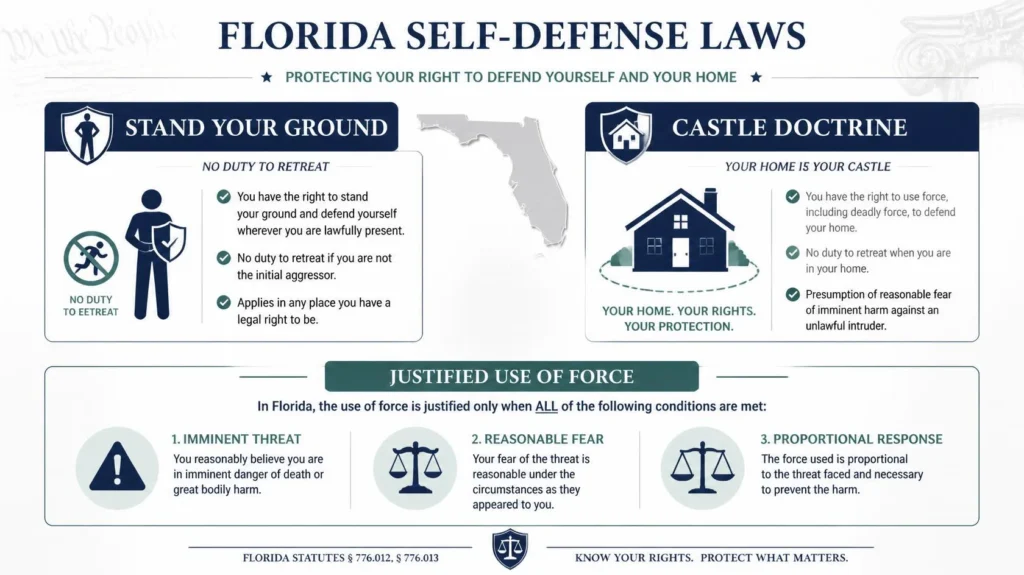
Florida is well-known for its robust self-defense statutes, particularly the “Stand Your Ground” law. This legislation, codified in Florida Statutes, grants individuals the right to use deadly force without a duty to retreat if they reasonably believe it is necessary to prevent death or great bodily harm to themselves or others, or to prevent the commission of a forcible felony. Understanding what is the stand your ground law is fundamental, but its application is often nuanced and subject to judicial interpretation based on specific facts of a case.
The broader use of force laws in Florida, including those related to the defense of property and persons, are intricate. Read more → These statutes outline the permissible levels of force, distinguishing between non-deadly and deadly force, and the circumstances under which each can be lawfully employed. A thorough understanding of use of force case law is critical, as court decisions continually shape how these laws are applied in real-world scenarios. For instance, the “Castle Doctrine” provides additional protections within one’s home, vehicle, or occupied dwelling. Navigating these self-defense gun laws requires an attorney well-versed in their complexities. Read more →
| Aspecto Legal | Stand Your Ground Law | Castle Doctrine |
|---|---|---|
| Duty to Retreat | No duty to retreat if lawfully present and facing reasonable threat of death/great bodily harm. | No duty to retreat when in one’s home, vehicle, or occupied dwelling. |
| Location of Incident | Any place where a person has a legal right to be. | Limited to one’s home, vehicle, or occupied dwelling. |
| Presumption of Fear | Generally requires proving reasonable fear. | Presumes reasonable fear of death/great bodily harm if intruder unlawfully enters. |
| Immunity from Prosecution | Yes, if use of force is justified under the law. | Yes, if use of force is justified under the law. |
The Legal Journey: From Investigation to Courtroom
The post shooting legal process is a multi-stage journey, beginning with a meticulous police investigation. Law enforcement will collect evidence, interview witnesses, and potentially question the individual involved. This initial phase is critical, and any statements made without legal counsel can be used against you. Following the investigation, the prosecutor’s office will review the evidence to determine whether to file charges. In some cases, a grand jury may be convened to decide if there is sufficient evidence to proceed with an indictment.
If charges are filed, the case moves into the pre-trial phase. A crucial aspect here is the possibility of an immunity hearing under Florida’s stand your ground law. If successful, this hearing can result in the dismissal of charges, as the law provides immunity from criminal prosecution and civil action for the lawful use of force. However, winning an immunity hearing requires presenting a compelling case, often involving expert testimony and detailed factual arguments. Should the case proceed to trial, the burden shifts to the prosecution to prove beyond a reasonable doubt that the use of force was not justified. The complexities of this legal journey underscore the necessity of an experienced firearm defense attorney.
Local Nuances: Palm Beach, Miami-Dade, and Broward Counties
While Florida’s self-defense laws apply statewide, the practical application and prosecutorial approaches can exhibit subtle differences across South Florida’s diverse judicial circuits. In Palm Beach County, known for its blend of urban and suburban communities, the State Attorney’s Office may approach use of force case law with a particular emphasis on the reasonableness of the perceived threat, often influenced by the specific demographics and community expectations of areas like West Palm Beach or Boca Raton. For instance, a case in a quiet Jupiter neighborhood might be viewed differently than one in a densely populated urban center.
Miami-Dade County, as the most populous county, presents a unique landscape. The sheer volume of cases and the diverse cultural backgrounds of its residents, from Miami to Hialeah and Coral Gables, can influence jury pools and public perception. Prosecutors here are accustomed to high-profile cases and may pursue charges aggressively, making the role of a firearm defense attorney even more critical in navigating the post shooting legal process.
Broward County, encompassing cities like Fort Lauderdale, Hollywood, and Pembroke Pines, often sees a balance between the approaches of its neighboring counties. While self-defense gun laws are uniformly applied, the local legal community and specific judicial interpretations can vary. Understanding these regional distinctions is paramount for crafting an effective defense strategy, as Dominique Russo and her team are well-equipped to do.
| Aspecto Regional | Palm Beach County | Miami-Dade County | Broward County |
|---|---|---|---|
| Prosecutorial Approach | Focus on reasonableness, influenced by varied demographics. | Often aggressive, high volume of cases, diverse jury pools. | Balanced approach, influenced by local legal community. |
| Jury Demographics | Mix of suburban and urban perspectives. | Highly diverse, multicultural, potentially varied views on self-defense. | Broad representation, reflecting a mix of urban and residential areas. |
| Judicial Interpretations | Can vary by specific judges and court divisions. | Influenced by high-profile cases and appellate decisions. | Generally consistent with state law, but local precedents may arise. |
Why a Firearm Defense Attorney is Crucial for the post shooting legal process
Facing the aftermath of a self-defense shooting without expert legal representation is a perilous undertaking. A specialized firearm defense attorney possesses an in-depth understanding of self-defense gun laws, use of force laws, and the intricate use of force case law that governs these situations. They can immediately advise you on your rights, guide you through police questioning, and gather critical evidence to support your claim of self-defense.
An attorney like Dominique Russo can meticulously prepare for an immunity hearing, challenging the prosecution’s narrative and presenting a compelling argument for why your actions were legally justified. They understand the nuances of the post shooting legal process in Palm Beach, Miami-Dade, and Broward Counties, leveraging local knowledge to your advantage. From protecting your rights during initial questioning to advocating for you in court, a dedicated legal professional is your strongest ally in navigating this challenging time.
Legal Disclaimer
Disclaimer: This article provides general information and is not intended as legal advice. The specifics of any self-defense incident are unique, and the legal outcomes depend heavily on individual circumstances and applicable laws. Always consult with a qualified attorney for advice tailored to your situation.
Conclusion
The post shooting legal process is undeniably one of the most challenging experiences an individual can face. From the immediate aftermath to potential court proceedings, every step is fraught with legal complexities and significant implications. Understanding your rights, knowing the intricacies of Florida’s self-defense gun laws, and securing immediate, expert legal representation are not merely recommendations, they are necessities. For residents of Palm Beach County, Miami-Dade County, and Broward County, having a knowledgeable firearm defense attorney by your side, such as Dominique Russo, can make all the difference in protecting your future.
Relevant Florida Statutes
Understanding the specific statutes that govern self-defense and the use of force in Florida is crucial. Key statutes include:
- Florida Statute 776.012: Use of force in defense of person.
- Florida Statute 776.013: Home protection; use of deadly force; presumption of fear of death or great bodily harm.
- Florida Statute 776.032: Immunity from criminal prosecution and civil action for use of lawful force.
These statutes provide the legal framework for self-defense claims in Florida. It is important to consult with a legal professional to understand how these laws apply to your specific situation.
Frequently Asked Questions (FAQ) about the post shooting legal process
What should I do immediately after a self-defense shooting?
Immediately after a self-defense shooting, ensure safety, call 911, and report the incident stating you acted in self-defense. Cooperate with law enforcement by identifying yourself, but politely decline to discuss details until your attorney is present. This protects your rights during the critical initial phase of the post shooting legal process.
What is Florida’s Stand Your Ground law in relation to the post shooting legal process?
Florida’s Stand Your Ground law permits individuals to use deadly force without a duty to retreat if they reasonably believe it’s necessary to prevent death or great bodily harm, or a forcible felony. This law is a crucial defense in the post shooting legal process, potentially leading to immunity from prosecution if the force used is deemed lawful.
Can I be arrested even if I acted in self-defense?
Yes, it is possible to be arrested even if you believe you acted in self-defense. Law enforcement must conduct a thorough investigation, and sometimes an arrest is made to allow for further inquiry. This is why having a firearm defense attorney from the outset is vital to navigate the complexities of the post shooting legal process and assert your defense.
How does a firearm defense attorney assist during the post shooting legal process?
A firearm defense attorney provides immediate legal counsel, protects your rights during police questioning, gathers evidence, and can represent you in immunity hearings. Their expertise in self-defense gun laws and use of force case law is indispensable for building a strong defense and guiding you through every stage of the post shooting legal process.
Are there differences in the post shooting legal process across South Florida counties?
While state laws are uniform, prosecutorial approaches and jury demographics can vary across Palm Beach, Miami-Dade, and Broward Counties. These local nuances can influence how a case is handled, from initial charges to trial strategy. An attorney with local experience, like Dominique Russo, understands these regional distinctions in the post shooting legal process.
Get a Defense Attorney Now
Contact Dominique Russo at Russo Law & Advocacy for a free consultation. We serve clients across South Florida, including:
- Palm Beach County (West Palm Beach, Boca Raton, Jupiter)
- Broward County (Fort Lauderdale, Hollywood, Pembroke Pines)
- Miami-Dade County (Miami, Coral Gables, Hialeah)